
I am Takayuki Maeda (X: TaKOBKi, GitHub: TaKO8Ki), a Rust compiler maintainer and a Staff Software Engineer based in Kyoto, Japan. I am looking for a role where I can apply my experience with Rust and open source, ideally with time to contribute upstream to projects such as the Rust compiler.
I have contributed to the Rust compiler for several years, mostly outside working hours. My current company is a great place to work, but I am looking for a role where compiler contributions can be part of my responsibilities. So far, I have had little success finding such a position, either in Japan or with a remote employer that can hire someone based in Japan, so I have decided to make my search public.
The role does not need to focus exclusively on open source. I would also be excited to use Rust to solve interesting and challenging technical problems.
Some numbers
Open-source work is difficult to measure, but here are a few numbers. At the time of writing:
-
I have authored more than 500 commits and 230 merged pull requests in the repository.
-
I have reviewed 130 closed pull requests.
-
Between May 2 and August 2, 2026, I made 44 commits to
rust-lang/rust, ranking 30th on the contributors graph for that three-month period.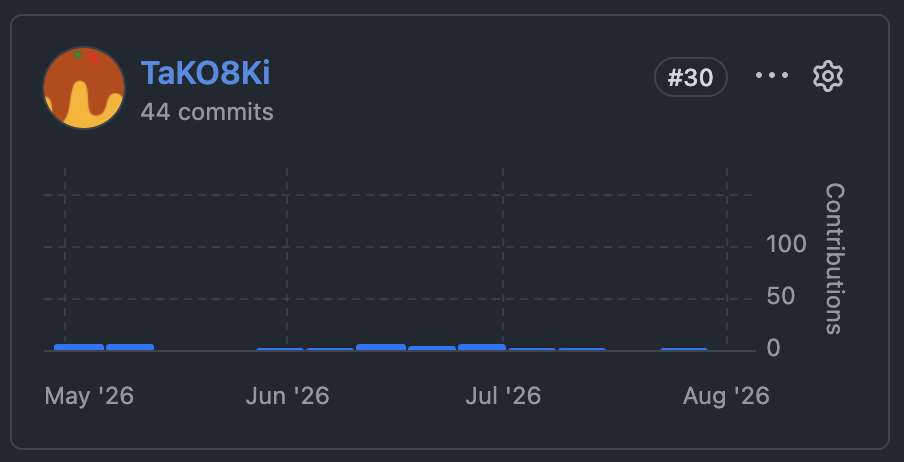
-
I rank 120th on the Rust all-time contributors list, with 605 contributions among more than 10,500 contributors.

Areas of expertise
I joined the Rust compiler team in 2022 as a compiler contributor, the title then used for people who contributed regularly. In 2023, I was selected as a Rust Foundation Fellow, focusing on compiler diagnostics, compiler bugs, and internal compiler improvements.
The team roles were reorganized in 2024. Maintainers are regular contributors who also help shape the compiler’s direction and long-term health. I am now a Rust Compiler Maintainer and a member of the Compiler FCP team and Diagnostics working area.
Most of my work is in the compiler frontend. Areas where I have particular depth include:
- Compiler diagnostics, suggestions, and diagnostic infrastructure
- Parsing and parser error recovery
- Closure capture analysis, including closure, coroutine, and async semantics
- HIR lowering and type checking for experimental language features
- Fixing internal compiler errors and regressions
Beyond the compiler, I have made smaller contributions to Clippy, rustfmt, rustdoc, Diesel, and Ruff. I also maintain RTK.
Selected Rust compiler work
Compiler diagnostics
Improving compiler error messages, warnings, and suggestions has been one of my longest-running areas of work.
The list of closed diagnostics issues assigned to me gives a broader view of this work. Many diagnostic changes are intentionally small and focused, but some larger examples include:
- Collapsing multiple dead-code warnings into a single diagnostic, which reworked dead-code lint reporting so that related unused fields or variants can be reported together rather than through repeated diagnostics.
- Suggesting a floating-point literal when dividing a floating-point value by an integer literal, which involved carrying operator-expression context through type checking and trait obligations to produce a useful suggestion such as
100.0. - Pointing to type parameter definitions when a variant, method, or associated item cannot be found, improving errors by connecting the failed lookup to the relevant type definition.
Move expressions
I am one of the task owners for move expressions in Rust’s accepted 2026 ergonomic ref-counting project goal.
Move expressions provide syntax such as move(expr) for explicit by-value capture in closures. They allow programmers to control precisely what a closure captures and when, without making every capture use the semantics of a move closure.
I implemented the initial experimental support for move expressions in ordinary closures. I am now working to extend the implementation to coroutine closures and async blocks.
This work spans several parts of the compiler, including parsing, feature gating, closure capture analysis, type checking, lowering, diagnostics, and test coverage. It also requires considering how the feature interacts with existing closure, coroutine, and async semantics.
Packages as optional namespaces
I am also working on compiler support for packages as optional namespaces, an accepted proposal that allows crate owners to publish related packages with names such as foo::bar.
My work focuses on name resolution and linking namespaced crates through root modules. This requires extending how the compiler represents and resolves external crates while preserving the behavior of ordinary crates and modules.
The implementation is still in progress. I have adapted earlier prototypes to recent compiler changes and split the larger design into reviewable pieces. My current work addresses interactions between external crates, modules, and macros in rust-lang/rust#158724.
Other Rust and production work
I am also a maintainer and core contributor to RTK, an open-source Rust command-line tool that filters common development command output to reduce the number of tokens consumed by coding agents.
In my current role, I work on production backend systems and infrastructure using Rust, Go, Ruby, Kotlin, and TypeScript. My experience includes APIs, databases, asynchronous processing, distributed systems, AWS, Kubernetes, Terraform, and operating services in production. As a Staff Software Engineer, I also make architectural decisions, investigate production issues, and work across team boundaries.
What I am looking for
My strongest preference is for work involving Rust-based open-source developer tools. I am particularly interested in:
- Compilers and programming-language tooling
- Build systems and package managers
- Static-analysis and developer-productivity tools
- Databases and distributed systems
- Infrastructure and systems software
I would particularly value dedicated time to continue contributing to the Rust compiler.
Open-source development does not need to be the sole focus. I would also consider a product-focused position if the technical work is interesting and Rust is used substantially.
I am based in Kyoto and am looking for full-time remote employment that allows me to remain in Japan. I am comfortable working across time zones and traveling for scheduled in-person collaboration once a quarter or twice a year, whether for a few days or a couple of weeks.
To make the scope of my search clear, I am not considering roles primarily focused on:
- Blockchain or cryptocurrencies
- Algorithmic trading
My GitHub profile is TaKO8Ki. If you know of a position that might be a good fit, please contact me via LinkedIn or email.
The structure of this post was inspired by Nicholas Nethercote’s post about looking for a new job.
Thank you for reading.